
Loading
Preparing your coverage insights...
Our Locations
Loading
Preparing your coverage insights...
Pittsburgh, PA
Dragon Insurance is an independent agency licensed in Pennsylvania, writing car insurance for drivers across Pittsburgh and Allegheny County. Full coverage here averages around $120 a month, which lands within a few dollars of the statewide figure, so the real question for most Pittsburgh drivers is not whether the city is expensive. It is whether their own renewal has drifted above what the market would charge them today. We price your profile across our carrier panel and tell you which one wins.
Call for a quote on the spot. Online requests answered within 1 hour on business days.
Quick Answer
Three things decide whether a Pittsburgh policy is priced right.
Want the statewide picture before you call? Read our guide to Pennsylvania car insurance requirements and cost.
Not sure how carrier comparison actually works? Read our guide to comparing auto insurance quotes.
Priced against a full panel, not one company
Progressive, Safeco, Liberty Mutual, GEICO, Plymouth Rock and more, quoted against the same Pittsburgh profile so you see the spread instead of one company's answer.
Limited Tort or Full Tort, decided on purpose
Pennsylvania makes the election mandatory and it holds for the term. We show the dollar gap between the two, explain the serious injury threshold, and place the policy on the one you actually pick.
Uninsured motorist limits you actually chose
Pennsylvania lets you reject UM and UIM in writing, and plenty of Pittsburgh drivers did without noticing. We quote those limits openly and match them to your liability unless you decide otherwise.
90+ five-star reviews
Real clients across Pennsylvania who came back at renewal because a licensed agent picked up the phone the first time.
Pennsylvania is a choice no-fault state. Every Pittsburgh policy has to meet the liability floor, carry first party medical benefits, and record a tort election. Here is what the Commonwealth requires, and what experienced Allegheny County drivers usually buy instead.
| Coverage | PA Minimum | Recommended |
|---|---|---|
| Bodily Injury Liability | $15,000 / $30,000 | $100,000 / $300,000 |
| Property Damage Liability | $5,000 | $100,000 |
| First Party Medical Benefits | $5,000 | $25,000 or higher |
| Tort Election | Required: Limited Tort or Full Tort | Full Tort, budget permitting |
| Uninsured / Underinsured Motorist | Not required, must be offered, rejection in writing | Match your liability limits |
| Collision | Not required | Required if financed or leased |
| Proof of Financial Responsibility | Required at stops, crashes & registration | Keep coverage continuous |
State minimums are the legal floor, not a coverage recommendation. Pennsylvania's $5,000 property damage limit does not replace a late-model SUV, and $15,000 of bodily injury per person can be gone before a hospital stay ends. Pennsylvania also permits credit-based insurance scoring, so your rate can reflect your US credit file. Call us to set limits and a tort election that match your situation.
Pittsburgh is one of the rare large cities that does not carry a big-city penalty. MoneyGeek's 2026 figures put full coverage in the city at around $120 a month against a Pennsylvania average near $117. Three dollars of difference is close enough to call it par, and that is genuinely good news, especially set against Philadelphia, where the gap runs the other way and runs wide.
| Profile | Typical monthly | Typical annual |
|---|---|---|
| Pittsburgh, full coverage | Around $120 | Around $1,440 |
| Pennsylvania statewide, full coverage | Around $117 | Around $1,407 |
| Pennsylvania statewide, minimum coverage | Around $47 | Around $568 |
Figures from MoneyGeek's 2026 Pennsylvania rate analysis, stated as averages. Note the third row carefully: that minimum-coverage number is the Pennsylvania statewide average, not a Pittsburgh average. A Pittsburgh-specific minimum-coverage figure was not published, and we will not invent one. Your actual premium depends on your garaging ZIP code, record, vehicle, tort election, and carrier.
Because the city average is unremarkable, a Pittsburgh renewal that looks high is usually telling you something about the carrier rather than the city. Rating factors move quietly between terms: a violation ages off, a teen joins the policy, a vehicle changes, a carrier files a new rate for Allegheny County. Any one of those can put you well above $120 a month while the notice in your mailbox says nothing except the new amount due. Comparing at renewal is how you find out which one it was, and we can rewrite you mid-term if the answer is bad enough.
Pittsburgh has 446 bridges, three rivers, and terrain steep enough that two neighborhoods a mile apart can have completely different drives. A commute here is defined less by distance than by what it has to cross. A Brookline to Downtown trip and a Squirrel Hill to Downtown trip cover similar mileage and share almost nothing else.
That geography shows up in congestion. INRIX put Pittsburgh drivers at about 43 hours lost annually to traffic in 2024. The Squirrel Hill Tunnel and the Parkway East, I-376, carry the reputation for good reason: tunnels compress lanes and force merges, so a small incident ripples upstream fast and stays there. The stretch of I-376 between the tunnel and the Edgewood and Swissvale exits moves roughly 100,000 vehicles a day.
None of that appears on a rating sheet by name, but it drives the inputs that do. Annual mileage, commute distance, and garaging ZIP code are all rated, and stop-and-go tunnel traffic is where low-speed collisions come from. Those are the claims that quietly reprice a policy two terms later, which is why we ask about your actual route rather than accepting a round mileage estimate.
The other Pittsburgh-specific line item is road surface. Freeze-thaw cycles chew up pavement every winter, and the patching that follows leaves faded and shifted lane striping behind it. Pothole damage generally falls under collision with your deductible applying, which is why the highest deductible on a quote is often the wrong one to buy here. We price a lower deductible alongside it so you can see what the safety margin costs before you skip it.
Dragon Insurance writes across the City of Pittsburgh and the wider Allegheny County market. Worth knowing before you quote: a Pittsburgh, PA mailing address is also used by a number of separate municipalities, West Mifflin among them, so the city printed on your mail is not always the municipality your policy rates in. We confirm the real garaging address every time.
Lawrenceville
15201
South Side
15203
Mount Washington
15211
North Side
15212
Oakland
15213
Squirrel Hill
15217
Downtown / Strip District
15222
Bloomfield
15224
Brookline
15226
Shadyside
15232
See our Pittsburgh, PA location page for the full range of coverage we write, or review the rules that apply across the Commonwealth on our Pennsylvania auto insurance page.
Questions Pittsburgh drivers ask us most often.
Pennsylvania requires 15/30/5 liability: $15,000 bodily injury per person, $30,000 bodily injury per accident, and $5,000 property damage. Every policy must also carry at least $5,000 in first party medical benefits. On top of the limits, Pennsylvania makes you elect Limited Tort or Full Tort when the policy is issued. Those are statutory floors rather than a coverage plan, and a single serious crash on the Parkway East can exhaust $15,000 of bodily injury before the hospital bill is settled.
Limited Tort costs less each month but gives up your right to sue an at-fault driver for pain and suffering unless your injuries clear the serious injury threshold written into state law. Full Tort costs somewhat more and keeps that right intact for any injury. The premium gap is often smaller than Pittsburgh drivers expect, and the election applies to everyone listed on the policy, including teen drivers. We price both elections side by side so the cheaper one is a decision you made rather than a default you inherited.
No. Pennsylvania does not mandate uninsured or underinsured motorist coverage. Carriers must offer it and you may decline it, but the rejection has to be signed in writing, which is exactly why so many drivers do not realize they dropped it years ago. If a hit-and-run happens in a tunnel merge, or a driver with a lapsed policy hits you on Route 51, UM and UIM are the coverages that actually respond. We quote those limits as a visible line item and match them to your liability limits unless you tell us otherwise.
Yes. Pennsylvania requires financial responsibility on every registered vehicle, and you must be able to produce proof at a traffic stop, after a crash, and at registration. PennDOT runs electronic verification against carrier records, so a lapse can surface with no police contact at all and can lead to registration suspension plus a restoration fee. A paper card or a digital ID card on your phone both count. Continuous coverage also protects your price, because most carriers rate a prior lapse for years afterward.
MoneyGeek's 2026 rate analysis puts full coverage in Pittsburgh at around $120 a month, roughly $1,440 a year. For context, Pennsylvania statewide averages run about $117 a month for full coverage and about $47 a month, roughly $568 a year, for minimum coverage. That $47 figure is the Pennsylvania statewide number, not a Pittsburgh number, because a Pittsburgh-specific minimum-coverage average was not published. Your own premium typically moves with your ZIP code, driving record, vehicle, tort election, and the carrier that ends up writing you.
Barely. Pittsburgh full coverage averages around $120 a month against a Pennsylvania average near $117, per MoneyGeek. A few dollars of gap is unusual for a city this size, and it is a completely different story from Philadelphia, where big-city pricing genuinely bites. The practical takeaway is that Pittsburgh drivers cannot blame geography for a high renewal. If your premium sits well above that range, the likelier explanation is your carrier, your tort election, or a rating factor that quietly changed since the last time you shopped.
Not by name, but very much in effect. Carriers rate your garaging ZIP code, annual mileage, and commute distance, and in Pittsburgh those three swing hard depending on whether your drive crosses a river, a bridge, or a tunnel. INRIX data for 2024 put Pittsburgh drivers at about 43 hours a year lost to congestion, and the Squirrel Hill Tunnel and Parkway East carry a large share of it. The I-376 stretch from the tunnel out toward Edgewood and Swissvale moves roughly 100,000 vehicles a day. More stop-and-go time means more low-speed contact, and low-speed contact is what builds a claim history.
Usually under collision rather than comprehensive. Bending a rim or blowing a tire in a pothole is treated as a collision loss with your deductible applying, so a $600 wheel repair against a $1,000 deductible is not worth filing. Freeze-thaw damage and the faded, repeatedly repainted lane striping that follows a patching season are real Pittsburgh conditions, and both argue for a deductible you would actually use rather than the highest one that makes a quote look cheap. We show you what dropping from $1,000 to $500 typically costs so the trade is visible before you buy.
We write across the City of Pittsburgh, including Lawrenceville 15201, South Side 15203, Mount Washington 15211, North Side 15212, Oakland 15213, Squirrel Hill 15217, Downtown and the Strip District 15222, Bloomfield 15224, Brookline 15226, and Shadyside 15232. One local detail worth knowing: a Pittsburgh, PA mailing address is also used by several separate municipalities such as West Mifflin, so the city on your mail is not always the municipality you are rated in. We confirm the actual garaging address at quote time because it can move the number.
Pittsburgh, PA
Pittsburgh sits at the Pennsylvania average, so if your renewal does not, it is worth ten minutes to find out why. A licensed agent prices your profile across the panel, walks you through Limited Tort versus Full Tort, and places you with the carrier that wins on your numbers.
90+ five-star reviews · 2,500+ clients served · Independent agency, licensed in Pennsylvania
Blog
More guidance for Pittsburgh and Pennsylvania drivers.
May 19, 2026
Pennsylvania Car Insurance: Requirements, Cost, and How to Save (2026 Guide)
PA minimum coverage averages $50/month statewide. Full requirements, city-by-city rates, the full tort vs. limited tort decision, what happens after an accident, and 8 proven ways to lower your rate.
Read article →
April 24, 2026
How to Compare Auto Insurance Quotes (Step-by-Step)
What to review before you switch carriers, including liability limits, deductibles, and discounts that actually lower your rate.
Read article →
June 14, 2026
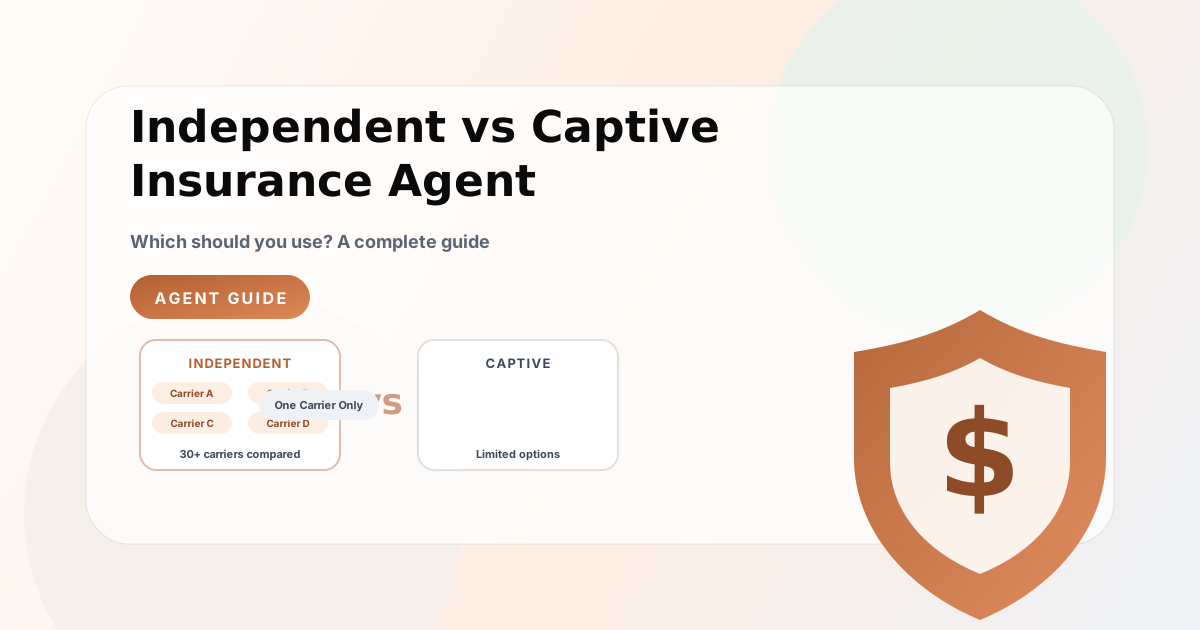
Independent vs Captive Insurance Agent: Which Should You Use?
An independent agent represents many carriers and compares them for you. A captive agent sells one company. Here is the difference, when each makes sense, and why more choice usually wins.
Read article →