Loading
Preparing your coverage insights...
Our Locations
Loading
Preparing your coverage insights...
An explainer on why home insurance rates keep rising in 2026 covering Insurify's projected 4% national increase, Virginia's 37% jump and Pennsylvania's 44% cumulative increase since 2021, the four structural drivers (reinsurance costs, extreme weather, rebuild inflation, carrier pullback), why comparing 30+ carriers matters more in a rising-rate market, five discount levers homeowners control, and Dragon's bilingual guidance for Nepali and Bhutanese homeowners across the states it serves.
Get a home insurance quote. One call compares the carriers we write side by side.
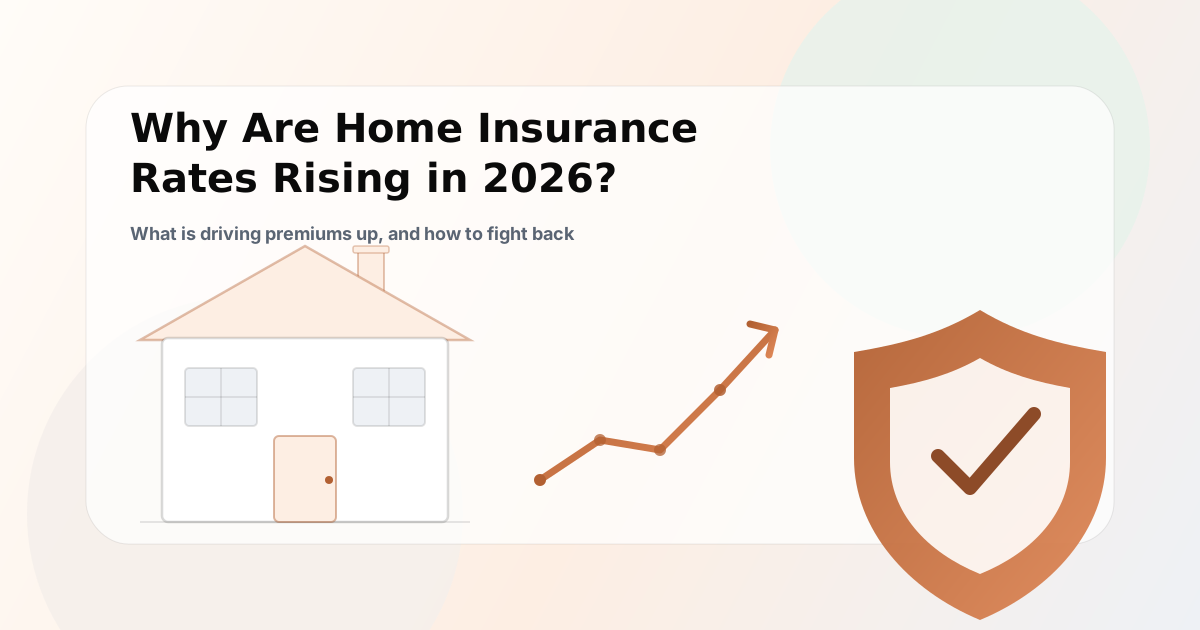
Home insurance rates are rising nationwide for the fifth consecutive year, with Insurify projecting an average 4% increase in 2026 that pushes the typical annual premium to roughly $3,057. In some states, the pain is far worse than the national number suggests. Virginia homeowners saw rates climb an estimated 37% in 2026 alone, according to Insurance.com's "State of Home Insurance 2026" report, and Pennsylvania homeowners absorbed a cumulative 44% premium increase between 2021 and 2024, per the Consumer Federation of America's April 2025 "Overburdened" report. If your bill jumped again this year, you are not imagining it and you are not alone. This guide explains what is actually driving the increases, and why shopping your policy across multiple carriers matters more now than it did five years ago.
Key takeaways
The rate environment is not uniform. National averages tell one story; individual states, especially the ones Dragon Insurance serves directly, tell another.
National
+4% in 2026
Average annual premium projected to reach approximately $3,057, marking the fifth consecutive year of increases, according to Insurify's 2026 rate-projection report.
Virginia
~37% in 2026
Named among the states with the steepest 2026 rate increases in the nation, according to Insurance.com's "State of Home Insurance 2026" report.
Pennsylvania
+44% (2021 to 2024)
Fourth-highest cumulative increase of any state over that period, per the Consumer Federation of America's April 2025 "Overburdened" report.
Dragon Insurance also serves homeowners in Texas, Maryland, Ohio, Tennessee, and Kentucky, where 2026 increases have generally tracked closer to the national average, with Texas remaining one of the highest-cost states overall due to hail, wind, and hurricane exposure. Whatever state you are in, the direction is the same: premiums are moving up, not down, and the reasons behind it are structural rather than personal. See how Dragon Insurance shops home coverage across the states we serve.
No single factor explains a five-year run of increases. It is the combination of four forces, each pushing in the same direction at the same time.
1. Reinsurance costs have climbed sharply
Home insurers buy their own insurance, called reinsurance, to protect themselves against catastrophic losses. After several years of billion-dollar weather events, reinsurance has become more expensive to buy. Carriers pass a portion of that cost directly into the premiums homeowners pay, regardless of whether that specific homeowner has ever filed a claim.
2. Extreme weather is generating more frequent claims
Severe convective storms, the kind that produce hail, high wind, and tornadoes, caused more than $52 billion in insured losses in 2025 alone, the third-highest total on record, according to Insurify's 2026 report. These storms are not limited to coastal or wildfire states; they hit the Midwest, Great Plains, and mid-Atlantic corridor, including the areas Dragon Insurance serves in Pennsylvania, Virginia, Ohio, Tennessee, and Kentucky.
3. Rebuilding a home costs more than it used to
Construction labor and materials have risen significantly since 2020. Every roof, every kitchen, every square foot of drywall costs more to replace than it did when many policies were originally priced. Carriers have had to raise dwelling coverage costs to keep pace with real rebuild costs, which is also why so many homeowners are now underinsured relative to what a full loss would actually cost to rebuild. Condo buildings feel the same pressure through the HOA master policy, where a higher premium can reach owners as higher dues or a special assessment, so we compare master policy quotes for boards at every renewal.
4. Some carriers are pulling back in higher-risk areas
When a carrier decides a state, county, or ZIP code is no longer profitable at current rates, it has two choices: raise rates sharply, or stop writing new business there. Both responses reduce competition in that market, which removes the natural downward pressure that comes from carriers competing for your business. This is exactly the dynamic behind Virginia's and Pennsylvania's outsized increases.
When rates are flat or falling, the difference between carriers is usually small, and staying put rarely costs you much. In a rising-rate environment, that gap widens fast, and the way most homeowners buy insurance leaves them with no way to see it.
A single-carrier customer is flying blind at renewal
If you bought your policy directly from one carrier, or through an agent who only represents that carrier, your renewal notice tells you what you owe, not whether it is competitive. Carriers reprice risk differently and at different times. One company's book of business in your ZIP code might be under pressure this year while another's is not, but you would have no way to know unless someone actually checks.
An independent agency can re-shop every renewal
Dragon Insurance is an independent agency, not tied to any single carrier. When your renewal arrives, we compare it against our full panel, including carriers like Safeco, Liberty Mutual, Foremost, and Openly, so you can see in one conversation whether your current premium still reflects the best available rate for your home, or whether it has drifted upward faster than the market has. See our carrier partners.
To be clear, comparing carriers does not make rate increases disappear. Reinsurance costs, storm frequency, and rebuild inflation are affecting every carrier in the market to some degree. What it does is make sure you are not paying more than you have to on top of an already-rising baseline, which is the part of the bill that is actually within your control.
You cannot control reinsurance markets or national storm trends. You can control the factors carriers use to price your specific policy. These five levers apply regardless of which carrier ultimately writes your coverage.
Bundle home and auto: save 15 to 25%
Bundling with the same carrier is consistently the largest single discount available, according to insurance.com research. As an independent agency, Dragon Insurance can bundle both policies with the same carrier, or price them separately if that saves more overall.
Replace an aging roof: save 5 to 35%
A roof replaced within the last five years, especially with impact-resistant shingles, can reduce premiums by 5 to 35% and is one of the few upgrades that both lowers your rate and reduces the odds you will file a claim in the first place.
Install monitored security: save 2 to 15%
A professionally monitored burglar and fire alarm system that alerts local authorities typically earns a 2 to 15% discount, depending on the carrier.
Raise your deductible: save 10 to 20%
Raising your deductible from $1,000 to $2,500 typically reduces premium by 10 to 20%, with Bankrate estimating average annual savings of $408. This only makes sense if you have an emergency fund that can cover the higher out-of-pocket cost at claim time.
Shop carriers at every renewal: save 15 to 40% or more
Loyalty discounts with a single carrier rarely outweigh the savings from re-shopping your policy annually. Carriers reprice risk every year, and the carrier with the best rate in 2023 is not necessarily the carrier with the best rate in 2026.
If your premium went up this year, do not assume there is nothing to be done. A short conversation before you renew can confirm whether your current rate is still competitive.
A note for Nepali and Bhutanese homeowners
For many first-generation Nepali and Bhutanese homeowners, the idea of re-shopping an insurance policy every year is unfamiliar. In many home countries, property insurance is either uncommon or purchased once with little expectation of comparing providers afterward. In the United States, carriers reprice risk annually, and simply staying with the same company out of loyalty can mean quietly overpaying year after year, especially in a rising-rate environment like 2026. At Dragon Insurance, we explain this clearly in English, Nepali, or Hindi, and we review policies for families every renewal so nothing gets missed because of language or unfamiliarity with how the U.S. system works.
Why is my home insurance going up if I have not filed a claim?
Rate increases are largely driven by factors outside your individual claims history: higher reinsurance costs, more frequent extreme-weather claims across the broader region, and rising construction costs for rebuilds. Insurify projects a 4% national average increase in 2026, the fifth consecutive year of increases, and carriers apply much of this at renewal even to policyholders with a clean claims record.
How much are home insurance rates rising in 2026?
Nationally, Insurify projects a 4% average increase in 2026, bringing the typical annual premium to roughly $3,057. Increases vary widely by state. Virginia was named among the states with the steepest 2026 increases at approximately 37%, according to Insurance.com's "State of Home Insurance 2026" report.
Why did Pennsylvania home insurance rates rise so much?
Pennsylvania homeowners saw a cumulative 44% increase in premiums from 2021 to 2024, the fourth-highest increase nationally, according to the Consumer Federation of America's April 2025 "Overburdened" report. Rising rebuild costs and increased severe-storm claims across the region are the primary drivers.
Why is Virginia home insurance rising so fast in 2026?
Virginia was flagged among the states with the steepest 2026 rate increases, at roughly 37%, according to Insurance.com's 2026 state-of-the-market report. Rising reinsurance costs and carriers adjusting their risk appetite in the state are cited as key factors, even though Virginia does not carry the same wildfire or Tornado Alley exposure as some other high-increase states.
Will comparing carriers actually lower my home insurance rate?
Comparing carriers cannot reverse industry-wide cost pressures like reinsurance and rebuild inflation, but it ensures you are not paying more than the current market requires. Because carriers reprice risk differently and at different times, the same home can receive meaningfully different quotes from different companies in the same year. An independent agency comparing 30+ carriers can identify that gap; a single carrier cannot show it to you.
What discounts can lower my home insurance premium regardless of carrier?
The most reliable levers are bundling home and auto (save 15 to 25%, per insurance.com), replacing an aging roof (save 5 to 35%), installing monitored security (save 2 to 15%), and raising your deductible from $1,000 to $2,500 (save 10 to 20%, average $408 per year per Bankrate). Shopping carriers at every renewal can add 15 to 40% or more in savings on top of these.
Should I switch home insurance carriers every year?
Not necessarily. Switching for its own sake is not the goal. The goal is confirming your current rate is still competitive before you renew. Sometimes your existing carrier remains the best option once discounts are applied; sometimes it is not. An independent agency can show you that comparison every year without you having to request quotes from a dozen companies yourself.
Does using an independent agency cost more than buying direct from one carrier?
No. Dragon Insurance is paid a commission by the carrier you ultimately choose, built into the premium the same way it would be if you bought directly. There is no added fee for comparing multiple carriers through us, and the comparison itself is what often uncovers the savings.
Rates are rising across the country, and in Pennsylvania and Virginia in particular, the increases have been especially steep. The one part of this you can control is whether your current premium reflects the best rate available to you today. It takes less than 10 minutes for Dragon Insurance to compare your renewal against our full carrier panel and tell you honestly whether you are paying a fair market rate or leaving money on the table.
Visit us: 1525 Cedar Cliff Dr STE 202, Camp Hill, PA 17011
Serving homeowners across Pennsylvania, Texas, Virginia, Maryland, Ohio, Tennessee, and Kentucky.
Last updated: July 2026. Dragon Insurance Services LLC is a licensed independent insurance agency. Rate figures cited are market-level averages and projections from third-party sources and do not constitute a quote or guarantee of specific pricing for any individual policy. Discount ranges vary by carrier and state. Contact us for a personalized comparison based on your property. Sources: Insurify, Insurance.com, Consumer Federation of America, Bankrate.
Explore Related Coverage
Ready to compare carriers and get a quote?
Dragon Insurance is an independent agency in Camp Hill, PA. We shop 30+ carriers to find your best rate.
Prefer to talk it through?
Get a real quote from a licensed advisor. English, Nepali, and Hindi spoken.
About the Author
Bimal GurungCEO, Agency Principal & Licensed Insurance Agent
Bimal Gurung is CEO and Agency Principal of Dragon Insurance Services, an independent agency in Camp Hill, PA that compares 30+ carriers for clients across Pennsylvania, Texas, Virginia, Maryland, Ohio, Tennessee, and Kentucky.
Meet the Dragon Insurance teamContinue Reading