Loading
Preparing your coverage insights...
Our Locations
Loading
Preparing your coverage insights...
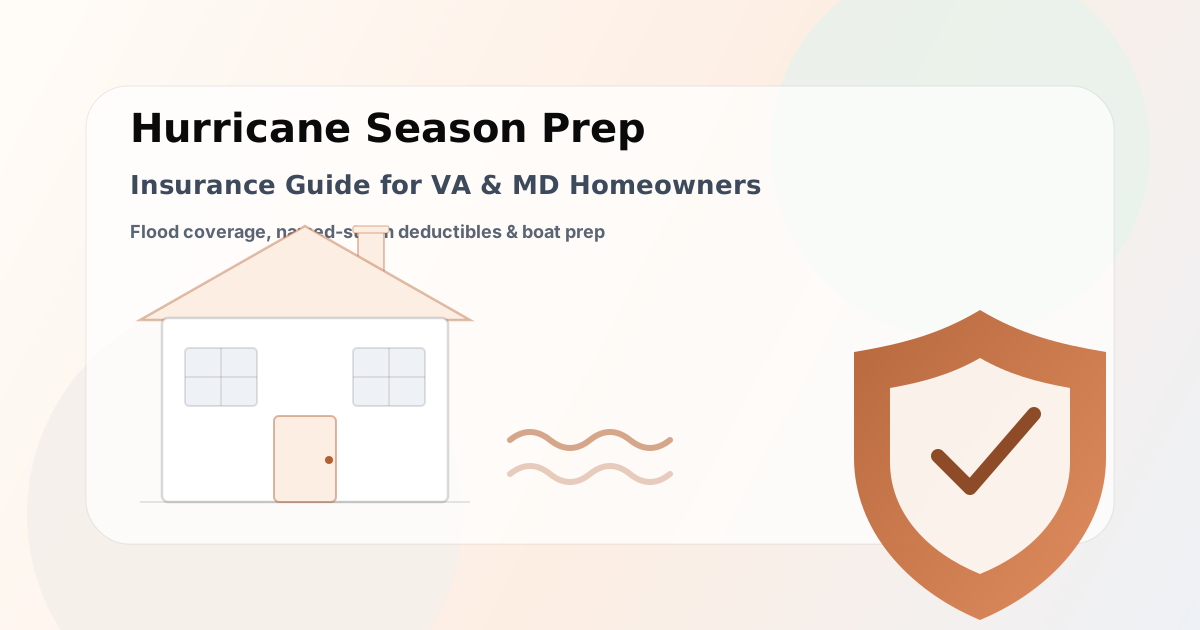
A pre-season guide for coastal Virginia and Maryland homeowners and boat owners covering why standard homeowners insurance never covers flood or storm surge, how named-storm deductibles work (1% to 5% of dwelling coverage), the NFIP's 30-day waiting period, boat haul-out warranty requirements, and a practical pre-season checklist.
Get a home insurance quote. One call compares the carriers we write side by side.
Quick Answer
Every June through November, coastal Virginia and Maryland homeowners and boat owners face the same two blind spots: they assume their homeowners policy covers flood and storm surge (it does not), and they do not know where to find their named-storm deductible on the declarations page until a claim forces the question. Neither mistake is about the strength of a given season. Even a below-normal year like the one NOAA is forecasting for 2026 still produces landfalling storms, and the financial exposure from being unprepared is the same regardless of how many storms form.
This guide walks through what a standard homeowners policy actually covers during hurricane season, how named-storm deductibles work in Virginia and Maryland, what boat owners on the Chesapeake Bay and Atlantic coastline need to check on their marine policy before a storm is named, and a practical checklist to work through before the next watch or warning is issued for your area.
Key Takeaways
Partially. A standard homeowners policy covers wind damage from a hurricane, but it never covers flood, storm surge, or tidal water, regardless of what caused the water to rise. Wind-driven rain that enters through a wind-damaged roof or broken window is typically covered under the wind portion of your policy. Water that comes up from the ground, a storm surge that pushes seawater into your home, or a river that overflows its banks is flood damage, and flood damage is excluded from every standard HO-3, HO-5, condo, or renters policy sold in Virginia or Maryland.
This single distinction, wind versus flood, is the most consequential thing a coastal Virginia or Maryland homeowner needs to understand before hurricane season, because it determines whether a claim gets paid or denied. The Virginia SCC's Bureau of Insurance states plainly that homeowners, renters, and commercial policies issued in Virginia typically do not cover damage caused by floods, surface water, or storm surge, and that flood coverage is sold separately through the federal National Flood Insurance Program (NFIP) or a private flood insurer.
If you live anywhere near the Chesapeake Bay, the Atlantic coastline, or a tidal river in Virginia or Maryland, storm surge is the single most likely way a hurricane damages your home, and it is the one loss type your homeowners policy will not pay for. Flood coverage has to be purchased as its own policy, either through:
Two details make timing critical. First, a new NFIP flood policy typically has a 30-day waiting period before it takes effect, according to the Virginia SCC, so a policy purchased once a storm is already approaching your area will usually not be in force in time to cover that storm. Second, mortgage lenders on homes in a FEMA-designated Special Flood Hazard Area are federally required to carry flood insurance as a loan condition, but homeowners outside that designated zone can still flood during a hurricane and often go without coverage because it was never required. Every year, a meaningful share of flood claims come from outside the mapped high-risk zones.
The most important sentence in this guide
If a hurricane or tropical storm pushes water into your home from the Chesapeake Bay, the Atlantic Ocean, or a swollen creek or river, your standard homeowners policy will not pay for that damage. Only a separate flood policy pays for storm surge and rising water. If you do not already have one and you live in a coastal or tidal area of Virginia or Maryland, this is the single most important call to make before hurricane season, not during it.
Homeowners near our Virginia Beach service area sit at the point where the Chesapeake Bay meets the Atlantic, and Chesapeake Bay communities near Baltimore face similar tidal exposure further up the Bay. Both areas warrant a flood coverage conversation even for homes outside the mapped Special Flood Hazard Area. Explore our home insurance coverage options to see how flood coverage fits alongside your homeowners policy.
Most homeowners think of their deductible as a flat dollar figure, commonly $1,000 or $2,500. In many coastal states, including Virginia and Maryland, insurers are permitted to apply a separate, larger deductible specifically for hurricane or named-storm damage, and this deductible is usually a percentage of your dwelling coverage limit, not a flat dollar amount. Virginia and Maryland are both included among the 19 states with hurricane or named-storm deductible provisions in place, according to the National Association of Insurance Commissioners (NAIC).
Named-storm and hurricane deductibles commonly range from 1% to 5% of your dwelling coverage limit, according to the Insurance Information Institute (III) and the NAIC. On a home insured for $300,000, a 2% named-storm deductible means the first $6,000 of damage from a covered named storm comes out of your pocket, before your insurer pays anything, which is a very different number than the $1,000 flat deductible many homeowners assume applies.
| Dwelling Coverage | 1% Named-Storm Deductible | 5% Named-Storm Deductible |
|---|---|---|
| $250,000 | $2,500 out of pocket | $12,500 out of pocket |
| $400,000 | $4,000 out of pocket | $20,000 out of pocket |
| $600,000 | $6,000 out of pocket | $30,000 out of pocket |
Illustrative figures based on the 1% to 5% named-storm deductible range reported by the NAIC and III. Your actual percentage, and whether a named-storm deductible applies at all, depends on your specific carrier and policy. Confirm your exact figure on your declarations page or ask Dragon Insurance to review it with you.
Whether the named-storm deductible actually applies to a given claim depends on the trigger written into your policy. For Virginia specifically, the deductible is typically triggered when the National Weather Service names a tropical storm or hurricane and issues a hurricane watch or warning covering any part of Virginia, according to the NAIC. Triggers vary by insurer and by state, so the exact wording in your policy controls, not a general rule of thumb. Condo owners have a second deductible to watch: many associations can pass the condo master policy deductible to unit owners, so we size HO-6 loss assessment coverage to match when we quote.
Your declarations page (often just called the "dec page") is the one- or two-page summary at the front of your policy packet that lists your coverage limits, premium, and deductibles. This is where a separate hurricane or named-storm deductible, if your policy has one, will be disclosed.
This is worth doing before June 1, not after a watch is issued for your coastline. If you are unsure what your current policy says, Dragon Insurance can pull your declarations page and walk through it with you at no cost.
Free Hurricane-Season Coverage Review
Know your flood status and your named-storm deductible before the season starts.
Dragon Insurance reviews your homeowners and boat coverage together, so you are not finding out what your policy actually says after a storm is already named.
Chesapeake Bay and Atlantic coastal boat owners face a version of the same problem as homeowners: assuming a standard marine policy behaves the same way during a named storm as it does the rest of the year. Two things to check on your boat policy before hurricane season begins:
Haul-out and hurricane warranty provisions
Many boat insurance policies include a named-storm or hurricane warranty clause requiring you to haul the boat out of the water, or move it to a designated safe harbor, once a watch or warning is issued for your area. Failing to comply with the haul-out requirement in your policy can result in a denied claim for that storm, even if the rest of your coverage is otherwise in force. Read your policy's storm plan requirements before hurricane season starts, not when a warning is already posted, and confirm what notice period and documentation your carrier expects.
Wind and named-storm damage coverage
Wind and named-storm damage to your hull, rigging, and equipment is generally covered under the comprehensive or physical damage portion of a standard boat policy, but coverage can carry its own named-storm deductible or exclusions in high-exposure coastal areas, similar in concept to a homeowners named-storm deductible. Confirm with your carrier whether any wind or named-storm exclusions or separate deductibles apply to your specific vessel and marina location before the season starts.
Dragon Insurance shops Progressive, Safeco, National General, and Foremost for boat coverage across our service area, including boat owners on the Chesapeake Bay near our Baltimore boat insurance service area and Atlantic and Bay boaters in Virginia Beach and Hampton Roads. We review named-storm haul-out provisions and wind coverage details with every boat owner we quote, since these terms differ by carrier and by navigation area.
Ask your marina about its own storm protocol as well. Most marinas along the Chesapeake Bay and Atlantic coastline have a written hurricane plan covering evacuation timing, additional dock lines, fender requirements, and whether the marina requires boats to be removed entirely ahead of a storm. Your marina's plan and your insurance policy's haul-out requirement are two separate things, and both need to be satisfied to avoid a denied claim or a damaged boat.
Work through this list before June 1, while there is no active storm to create time pressure. The Virginia SCC specifically recommends preparing a home inventory and confirming coverage details before a storm is named, since insurers commonly stop binding new hurricane-exposed coverage once a storm has already formed in the Atlantic.
A note for Nepali and Bhutanese families new to coastal Virginia and Maryland
Many Nepali and Bhutanese families who have settled in the Hampton Roads and Chesapeake Bay areas are experiencing hurricane season for the first time. In Nepal and Bhutan, the closest natural-disaster comparisons are monsoon flooding and landslides, not named tropical storms with formal watches, warnings, and evacuation zones, and the layered U.S. insurance system, homeowners policy plus a separate flood policy plus a possible named-storm deductible, can be confusing under time pressure.
Dragon Insurance explains flood coverage, named-storm deductibles, and boat haul-out requirements in plain English, Nepali, and Hindi, well before a storm is in the forecast. If you are new to a coastal Virginia or Maryland community, call us for a no-pressure review of what your current policy actually covers.
हामी नेपाली बोल्छौं. We speak Nepali.
Does homeowners insurance cover hurricane damage in Virginia and Maryland?
Partially. Wind damage from a hurricane, including wind-driven rain that enters through a wind-damaged roof or window, is generally covered under a standard homeowners policy. Flood damage, storm surge, and tidal water are never covered under a standard homeowners policy and require a separate NFIP or private flood policy, according to the Virginia State Corporation Commission.
What is a named-storm deductible?
A named-storm deductible is a separate, often larger deductible that applies specifically to damage from a hurricane or named tropical storm, instead of your regular flat-dollar deductible. It is commonly expressed as a percentage of your dwelling coverage, typically 1% to 5%, rather than a fixed dollar amount, according to the NAIC and the Insurance Information Institute. Virginia and Maryland are both among the states where insurers can apply this type of deductible.
How do I know if my policy has a named-storm deductible?
Check your declarations page for a line item separate from your standard deductible, often labeled "Hurricane Deductible," "Named Storm Deductible," or "Wind/Hail Deductible." If it is shown as a percentage rather than a dollar amount, it applies to your dwelling coverage limit. If you cannot find it or are unsure, Dragon Insurance can review your declarations page with you at no cost.
Does flood insurance take effect immediately after I buy it?
No. A new National Flood Insurance Program (NFIP) policy typically has a 30-day waiting period before it takes effect, according to the Virginia SCC. This means buying flood coverage once a storm is already approaching your area is usually too late for that specific storm, which is why flood coverage decisions need to happen before hurricane season, not during a watch or warning.
Is boat insurance affected during hurricane season?
Many boat insurance policies include a named-storm or hurricane warranty clause requiring the boat to be hauled out of the water or moved to a designated safe location once a watch or warning is issued. Not complying with this requirement can result in a denied claim for that storm. Wind and named-storm damage is generally covered under the comprehensive or physical damage portion of a standard boat policy, though some coastal policies carry their own named-storm deductible or exclusions, so confirm the specific terms with your carrier.
How active will the 2026 Atlantic hurricane season be?
NOAA's 2026 outlook forecasts a below-normal season, with 8 to 14 named storms and 3 to 6 hurricanes expected, below the 30-year average. A below-normal forecast still means landfalling storms are possible, and preparation steps like confirming flood coverage and locating your named-storm deductible are the same regardless of how active the season turns out to be.
Can I still buy homeowners or flood insurance once a hurricane has already formed?
It becomes difficult. Once a tropical storm or hurricane develops in the Atlantic, many insurers stop binding new hurricane-exposed coverage, or new flood policies simply have not cleared their waiting period, until after the storm threat passes, according to the Virginia SCC. The practical takeaway is to review and buy coverage during the calm part of the season, not once a storm is being tracked toward your coastline.
What should I photograph before hurricane season for insurance purposes?
Photograph or video every room of your home, your roof and exterior, and any high-value belongings, and store the files off the property, such as in cloud storage or with a family member. A written inventory with approximate purchase dates and values speeds up a personal property claim considerably. The Virginia SCC specifically recommends completing a home inventory before hurricane season begins.
Does Dragon Insurance sell flood insurance in Virginia and Maryland?
Dragon Insurance helps homeowners in Virginia and Maryland understand their flood exposure and connect with NFIP and private flood coverage options alongside their homeowners policy. Call 717-229-5115 or request a quote online to review your current coverage before hurricane season.
Dragon Insurance reviews homeowners and boat policies for coastal Virginia and Maryland clients so that flood status, named-storm deductibles, and boat haul-out requirements are all understood before the season starts, not discovered during a claim.
Visit us: 1525 Cedar Cliff Dr STE 202, Camp Hill, PA 17011
Serving coastal and inland Virginia and Maryland homeowners and boat owners, along with PA, TX, OH, TN, and KY. English, Nepali, and Hindi spoken.
Dragon Insurance Services LLC is a licensed independent insurance agency. This guide reflects publicly available NOAA, Virginia SCC, NAIC, and III information current as of 2026 and general policy practices; it is not a substitute for reviewing your own policy documents. Named-storm deductible percentages, flood policy waiting periods, and boat haul-out requirements vary by carrier and policy. Contact us to review your specific coverage before hurricane season.
Explore Related Coverage
Ready to compare carriers and get a quote?
Dragon Insurance is an independent agency in Camp Hill, PA. We shop 30+ carriers to find your best rate.
Prefer to talk it through?
Get a real quote from a licensed advisor. English, Nepali, and Hindi spoken.
About the Author
Bimal GurungCEO, Agency Principal & Licensed Insurance Agent
Bimal Gurung is CEO and Agency Principal of Dragon Insurance Services, an independent agency in Camp Hill, PA that compares 30+ carriers for clients across Pennsylvania, Texas, Virginia, Maryland, Ohio, Tennessee, and Kentucky.
Meet the Dragon Insurance teamContinue Reading