Loading
Preparing your coverage insights...
Our Locations
Loading
Preparing your coverage insights...
A clear comparison of excess liability vs umbrella insurance: what excess liability coverage is, what umbrella adds, a side-by-side table, when each applies (personal vs commercial), cost ranges, by-state personal umbrella pricing across the states Dragon serves, and how the limits stack in a real claim. Dragon places both through Safeco, Liberty Mutual, AAA, and Foremost.
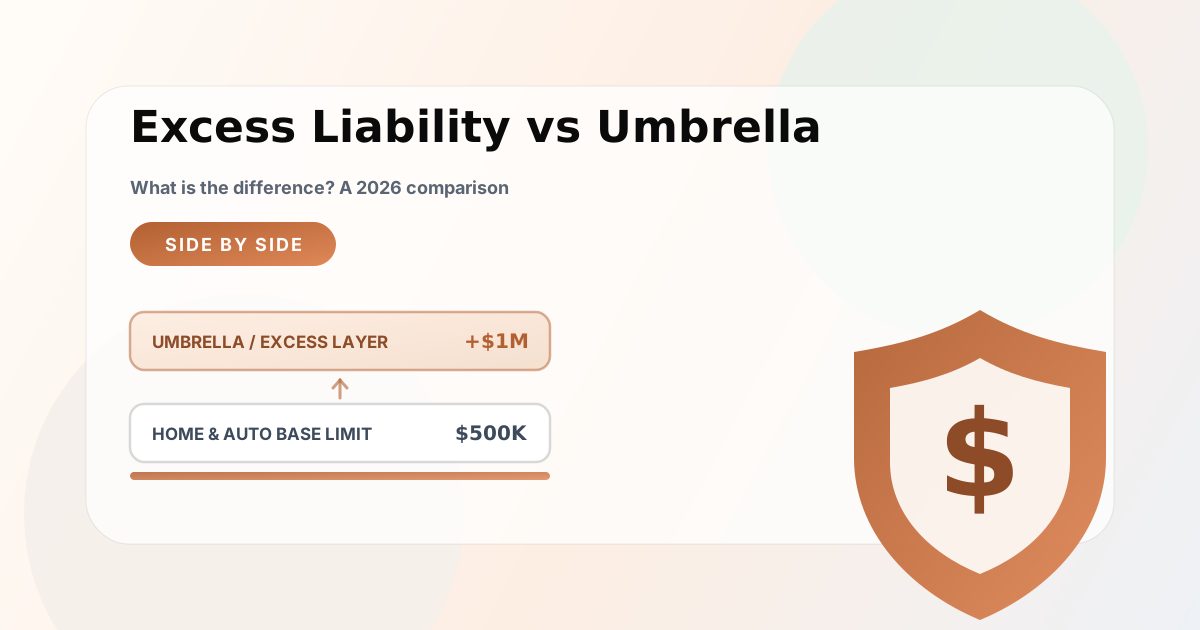
Excess liability and umbrella insurance sound interchangeable, and brokers often use the words as if they mean the same thing. They do not. Both sit on top of your existing policies and add a fresh layer of liability protection, but they cover claims differently, and choosing the wrong one can leave a gap exactly where you needed coverage most. This guide draws a clean line between the two so you can pick with confidence.
As an independent agency, Dragon Insurance places both personal umbrella and excess liability coverage through carriers on our panel, including Safeco, Liberty Mutual, AAA, and Foremost. For the product itself, see our personal umbrella insurance page. For the commercial excess angle on a business, see our general liability guide.
Key Takeaways
Quick Answer
What is the difference between excess liability and umbrella insurance?
The difference is breadth of coverage. Umbrella insurance adds a higher liability limit and can also cover some claims your underlying auto or home policy excludes, such as certain libel, slander, or worldwide liability situations. Excess liability adds a higher limit but follows the exact terms of the underlying policy, so it only pays more on claims the base policy already covers. Both layers sit on top of your existing limits and pay after those limits are used up. For most households a personal umbrella is the better fit; for many businesses a commercial excess liability policy matched to a specific underlying form is the right choice.
The excess liability vs umbrella debate comes down to one question: do you want a layer that simply adds more dollars on the same covered claims, or a layer that can also reach claims your base policy never covered? The table below puts the two side by side so the distinction is easy to see.
| Feature | Umbrella Insurance | Excess Liability |
|---|---|---|
| What it adds | More limit plus broader coverage | More limit only |
| Coverage terms | Can extend beyond the underlying policy | Follows the underlying policy exactly |
| Typical buyer | Households and families | Businesses with specific risk forms |
| Gap protection | Can fill some base-policy gaps | No new coverage; same gaps remain |
| Limit range | $1M to $5M (personal) | $1M to $25M+ (commercial) |
| Best use | Personal asset protection | Layered commercial liability towers |
In practice, many personal policies sold as umbrellas are technically excess on certain coverages, and some commercial umbrellas are broader than a strict excess form. Read the policy language, not just the name. Dragon reviews the actual form before you buy.
Excess liability coverage is a policy layer that increases the dollar limit available on claims your underlying policy already covers, without changing what is covered. It is a follow-form layer: it sits above a specific underlying policy, such as a commercial general liability or auto liability policy, and it responds on the same terms, conditions, and exclusions. If the base policy would not pay a claim, neither will the excess layer.
Here is how excess liability coverage works in a claim. Suppose a business carries $1 million of general liability and a $4 million excess liability policy on top. A covered lawsuit settles for $3.5 million. The general liability policy pays its $1 million limit, then the excess layer pays the remaining $2.5 million, up to its $4 million ceiling. The business pays nothing out of pocket beyond its deductible on the base policy.
For the underlying business policy that an excess layer usually sits on, see our general liability insurance for small businesses guide.
Umbrella insurance is a personal or commercial policy that adds a high liability limit on top of your auto, home, or business liability, and can also extend coverage to certain claims the underlying policy does not cover at all. That broadening is the key difference from a pure excess policy. A personal umbrella commonly adds coverage for personal injury offenses like libel and slander, and for liability that occurs anywhere in the world.
A worked example shows the breadth. A homeowner is sued for $1.2 million after a guest is seriously injured at a backyard gathering. Home liability of $500,000 pays first, then a $1 million personal umbrella pays the remaining $700,000. If the same homeowner later faces a defamation claim that the home policy excludes, a personal umbrella may still respond after a self-insured retention, while a strict excess policy following the home form would not.
When umbrella reaches further than excess
The personal versus commercial split is the fastest way to narrow your choice. Households want breadth and simplicity, so a personal umbrella usually wins. Businesses often need to match a precise underlying form and reach very high limits to satisfy a contract, so a follow-form excess liability layer is common.
Personal: choose umbrella
A family with a home, two cars, a teen driver, and some savings to protect is the classic umbrella buyer. The broader coverage and low price make it the default for personal asset protection. See our personal umbrella page.
Commercial: often excess
A contractor required to carry $5 million per a project agreement usually layers excess liability over a general liability and commercial auto base, matching the exact underlying terms the contract demands.
Personal umbrella pricing is remarkably affordable for the limit it buys. Commercial excess liability costs more because it sits over higher-hazard underlying policies and reaches much larger limits. The ranges below are typical 2026 starting points; your exact rate depends on the underlying policies, household or business risk, and state.
Figures below are general industry estimates. Not Dragon Insurance quotes. Call 717-229-5115 for your actual rate.
| Coverage | Limit | Typical Annual Cost |
|---|---|---|
| Personal umbrella | $1 million | $150 to $300 |
| Personal umbrella | $2 million | $230 to $450 |
| Personal umbrella | $5 million | $400 to $800 |
| Commercial excess liability | $1 million | $500 to $1,500 |
| Commercial excess liability | $5 million | $1,500 to $5,000+ |
Ranges reflect general industry guidance for 2026 based on NAIC and Insurance Information Institute data. Actual premiums depend on underwriting review and the underlying policies in place.
A $1 million personal umbrella is priced largely off your underlying auto and home liability, and those base rates vary by state. Here are typical $1 million umbrella ranges across the states Dragon serves, assuming standard underlying limits are already in place.
Figures below are general industry estimates. Not Dragon Insurance quotes. Call 717-229-5115 for your actual rate.
| State | $1M Umbrella Per Year | Key Cost Driver |
|---|---|---|
| Pennsylvania | $160 to $280 | Choice no-fault; underlying auto limits |
| Texas | $180 to $320 | Higher auto severity; large verdicts |
| Virginia | $150 to $260 | Lower loss exposure; competitive market |
| Maryland | $160 to $290 | Suburban density; underlying PIP rules |
| Ohio | $150 to $260 | Lower base rates statewide |
| Tennessee | $160 to $290 | High uninsured motorist exposure |
| Kentucky | $155 to $275 | No-fault state; underlying limits required |
Ranges are general industry estimates for households carrying standard underlying limits, based on NAIC and Insurance Information Institute data. Final pricing depends on your full risk profile and the carrier.
Property and liability insurance is the broad family of coverage that protects what you own and what you owe to others. Property and liability insurance includes your home or building coverage, your auto physical damage, and the liability portions of those policies. Excess liability and umbrella both belong to the liability side of that family. They never pay for property damage to your own things; they only add protection for what you might owe someone else.
Think of it as a stack. The bottom of your property and liability insurance is the base auto and home policy, which carries its own liability limits. On top of that base sits either an umbrella or an excess layer, adding height to the liability side only. Understanding this structure helps you avoid paying twice for the same protection, and it explains why carriers require minimum underlying limits before the upper layer attaches.
One intake. The right layer, priced across carriers.
Not sure if you need umbrella or excess? Ask Dragon.
Tell us your assets, policies, and state once. We compare umbrella and excess options through Safeco, Liberty Mutual, AAA, and Foremost with identical underlying limits.
The most useful thing to understand about either layer is the order of payment. Money flows from the bottom of the stack up, and the upper layer never pays until the layer below it is fully used. Walk through a $2.5 million auto liability claim with a $500,000 base limit and a $2 million upper layer on top.
The difference between umbrella and excess never shows up on a routine covered claim like this one. It shows up on the unusual claim, the libel suit or the worldwide incident, where a broader umbrella responds and a strict excess layer does not.
What is the difference between excess liability vs umbrella?
The difference is breadth. Umbrella insurance adds a higher liability limit and can also cover some claims your underlying auto or home policy excludes, such as libel, slander, or worldwide liability. Excess liability follows the exact terms of the underlying policy and only pays more on claims the base policy already covers. Both stack on top of your existing limits and pay only after those limits are exhausted.
What is excess liability coverage?
Excess liability coverage is a follow-form policy layer that increases the dollar limit available on claims your underlying policy already covers, without changing what is covered. It adopts the underlying policy's terms and exclusions exactly, attaches only after the base limit is exhausted, and is commonly stacked by businesses to reach $25 million or more. If the base policy would not pay a claim, the excess layer will not either.
What is property and liability insurance?
Property and liability insurance is the broad family of coverage that protects what you own and what you owe to others. The property side covers your home, building, or vehicle against physical damage, while the liability side covers what you might owe someone else for injury or damage. Umbrella and excess liability belong to the liability side, adding height to those limits; they never pay for damage to your own property.
Do I need umbrella or excess liability insurance?
Most households should choose a personal umbrella because it adds a high limit cheaply and can fill some gaps in the underlying home and auto policy. Businesses that must match a precise underlying form and reach very high contract-required limits often use a commercial excess liability layer instead. The right answer depends on your assets, your policies, and the claims you are most exposed to.
How much does a personal umbrella policy cost?
According to the Insurance Information Institute, a $1 million personal umbrella typically costs about $150 to $300 a year, with $2 million running roughly $230 to $450 and $5 million around $400 to $800. Price depends on your underlying auto and home limits, household risk, and state. Carriers usually require you to carry $250,000 or $300,000 of underlying liability before the umbrella attaches.
Is excess liability the same as umbrella insurance?
No, but they are closely related. Both sit above your base liability limits and pay after those limits are used. The difference is in coverage breadth: a personal umbrella can extend to claims your base home or auto policy does not cover at all, such as libel, slander, or worldwide liability. A true excess liability policy is follow-form, meaning it mirrors the underlying policy's terms exactly and adds only more dollars on the same covered claims. If the base policy would not pay a claim, the excess layer will not either. In practice, many personal policies marketed as umbrellas behave as excess on some coverages, so reading the actual policy language matters. Dragon reviews the form before you buy.
What is commercial excess liability insurance?
Commercial excess liability insurance is a follow-form policy that sits above a business's general liability, commercial auto, or other primary policy and adds a higher dollar limit on the same covered claims. It is most commonly used by contractors, manufacturers, and landlords that must meet high per-occurrence or aggregate limits required by project contracts or lenders. A typical structure layers $1 million to $5 million of excess coverage on top of a $1 million GL or auto base, allowing a business to reach $5 million of total coverage at a lower cost than buying that limit on the primary policy alone. Dragon quotes commercial excess liability through carriers on our panel for businesses across PA, TX, VA, MD, OH, TN, and KY.
Umbrella or excess, the goal is the same: protect your assets above your base limits without paying for coverage you already have. Dragon reads the actual policy form, matches it to your risk, and compares carriers so you buy the right layer at the right price.
Visit us: 1525 Cedar Cliff Dr STE 202, Camp Hill, PA 17011
Serving PA, TX, VA, MD, OH, TN, and KY. English, Nepali, and Hindi spoken.
Personal Umbrella Insurance
How a personal umbrella adds $1M or more above your home and auto liability. Free quote.
Read more

General Liability Insurance
The underlying business policy that commercial excess liability layers sit on top of.
Read more
Business Owner's Policy (BOP)
Bundle GL and property in one policy, then layer excess liability on top as you grow.
Read more
Dragon Insurance Services LLC is a licensed independent insurance agency. Cost figures in this article reflect 2026 third-party guidance and our agency's quoting experience across PA, TX, VA, MD, OH, TN, and KY; they are estimates, not guaranteed rates. Coverage differences between umbrella and excess depend on the actual policy form. Contact us for a personalized quote and a review of your specific policies.
Explore Related Coverage
Ready to compare carriers and get a quote?
Dragon Insurance is an independent agency in Camp Hill, PA. We shop 30+ carriers to find your best rate.
Prefer to talk it through?
Get a real quote from a licensed advisor. English, Nepali, and Hindi spoken.
About the Author
Bimal GurungCEO, Agency Principal & Licensed Insurance Agent
Bimal Gurung is CEO and Agency Principal of Dragon Insurance Services, an independent agency in Camp Hill, PA that compares 30+ carriers for clients across Pennsylvania, Texas, Virginia, Maryland, Ohio, Tennessee, and Kentucky.
Meet the Dragon Insurance teamContinue Reading