
Loading
Preparing your coverage insights...
Our Locations
Loading
Preparing your coverage insights...
Condo insurance (HO-6) covers your unit's interior, personal property, liability, and loss of use everything the HOA master policy leaves out. Learn what you need based on your HOA policy type.
Owning a condo is different from owning a house and insuring one is different too. Your HOA has a master insurance policy, but that policy almost certainly does not cover what is inside your unit, your personal belongings, or your personal liability. The gap between what your HOA covers and what you own is exactly what condo insurance (HO-6) fills. According to the Insurance Information Institute, condo ownership grew 10.8% between 2015 and 2023, making this a larger and more important coverage category every year.
Key takeaways
Your unit interior isn't the HOA's problem
If your kitchen floods tonight, the HOA's master policy will not pay to fix it.
We match your HO-6 to your HOA's actual master policy type so your unit interior, belongings, and liability are actually covered, not assumed. Get a same-day quote or call now.
Condo insurance (HO-6) is a policy designed specifically for condominium unit owners. It covers the interior of your unit, your personal belongings, your personal liability if a guest is injured in your home, and your additional living expenses if a covered event forces you to temporarily relocate. It is designed to work alongside your HOA's master policy covering what the master policy does not.
Dragon Insurance Services helps condo owners across Pennsylvania, Texas, Virginia, Maryland, Ohio, Tennessee, and Kentucky find the right HO-6 coverage to complement what their HOA provides. Explore our condo insurance coverage options or read on for the complete guide.
To understand exactly how much HO-6 coverage you need, you first need to know what type of master policy your HOA carries. There are two common types:
All-In (Comprehensive) Master Policy
Covers the building structure, common areas, and original fixtures and finishes inside each unit the floors, cabinets, and built-ins as they were when the building was constructed. This is the more favorable type for unit owners. Your HO-6 mainly needs to cover improvements you've made, your personal property, and your personal liability.
Bare Walls-In (Studs-Out) Master Policy
Covers only the bare structure exterior walls, roof, hallways, and common areas. Everything inside your unit original fixtures, flooring, cabinets, drywall is your responsibility. This type requires more robust unit coverage from your HO-6. Unit owners under a bare walls-in policy often need $30,000–$100,000+ in unit interior coverage depending on the size and finish level of their unit.
Important: Request a copy of your HOA's master policy declarations
You have the right as a unit owner to see the HOA's master policy. The declarations page will tell you the coverage type (all-in vs. bare walls-in) and the total limit. This information directly determines how much unit interior coverage to put on your HO-6. Your agent can review it with you.
Serving on your HOA or condo association board rather than owning a unit? The coverage your board needs to review, property, liability, directors and officers (D&O), and fidelity/crime coverage, is different from your own HO-6 policy. See our guide to HOA and condo association master policies for boards for the board-side breakdown.
Unit interior coverage (dwelling)
Covers damage to the interior of your unit walls, floors, ceilings, cabinets, built-in appliances, and any improvements you have made. The amount needed depends on your HOA master policy type. Under a bare walls-in policy, you should insure the full interior replacement cost. Under an all-in policy, coverage for your improvements above the original finishes is typically sufficient.
Personal property
Covers your furniture, electronics, clothing, kitchen appliances, and other personal belongings if they are stolen or damaged by a covered peril. Like homeowners insurance, choose replacement cost coverage over actual cash value ACV deducts depreciation at claim time, meaning a 5-year-old laptop pays out far less than what a new replacement costs.
Personal liability
Covers you if a guest is injured in your unit and sues, or if you accidentally cause damage to another unit (such as a water leak that damages your downstairs neighbor's unit). Standard HO-6 policies include $100,000–$300,000 in personal liability. For higher limits, pair your condo insurance with a personal umbrella policy.
Additional living expenses (ALE)
If a covered loss makes your unit uninhabitable fire, severe water damage, a major covered peril ALE pays for your hotel stays, meals above normal costs, and temporary housing while repairs are made. This coverage is typically 20–30% of your personal property limit.
Loss assessment coverage (critical add-on)
If the HOA's master policy limit is exhausted by a major claim a large fire in a common area, a major lawsuit against the HOA the remaining cost is assessed to all unit owners as a special assessment. Without loss assessment coverage, this assessment comes directly out of your pocket. Loss assessment coverage pays your share up to the policy limit and typically costs very little to add.
When the HOA's policy runs out, owners split the bill
A special assessment does not ask if you are ready for it.
We add loss assessment coverage to your HO-6 so a shortfall from a shared building claim doesn't turn into a bill with your name on it.
According to 2026 market data from NerdWallet, the national average HO-6 premium is approximately $499–$656/year ($42–$55/month) for a policy with $60,000 in personal property coverage, $300,000 in liability, and a $1,000 deductible, according to 2026 data from Insurance.com. Pennsylvania condo owners typically pay near the lower end of the national range approximately $380–$520/year for comparable coverage. Your actual rate depends on:
| Factor | How it affects cost |
|---|---|
| Unit size and location | Larger units with higher replacement costs cost more to insure |
| HOA master policy type | Bare walls-in requires more unit interior coverage, raising your HO-6 premium |
| Personal property value | Higher personal property limits increase the premium proportionally |
| Credit score | Most carriers in the states we serve use credit-based insurance scores as a rating factor |
| Bundling with auto insurance | Bundling condo and auto with the same carrier typically saves 5–20% on both |
Buying your first condo in the U.S.? What new homeowners need to know.
Many first-generation homebuyers in the Nepali and Bhutanese communities choose condos as their entry into U.S. homeownership and condo insurance is one of the most misunderstood coverage types. The key point: your HOA dues pay for the building's master insurance, but that policy does not protect anything inside your unit. If there is a fire, water leak, or theft, your belongings and the interior of your unit are only covered if you have your own HO-6 policy. Most mortgage lenders also require it as a loan condition. We can walk you through the HOA master policy and help you set the right coverage amount in English, Nepali, or Hindi.
We help condo owners understand the relationship between their HOA master policy and their individual HO-6, set the right amount of unit interior coverage, and find the most competitive policy across multiple carriers. If you are also a homeowner or renter, we can bundle your condo and auto insurance together for maximum savings.
Condo insurance (HO-6) rates depend on your unit interior coverage amount, location, personal property limit, and deductible. Call Dragon at 717-229-5115 for a same-day quote. Your average condo insurance cost depends on your unit interior coverage, personal property limit, loss assessment coverage, deductible, and location. Units in higher-value buildings, coastal zones, or older structures cost more. Because the HOA master policy decides how much of the structure you insure yourself, two condos of the same size can carry very different HO-6 premiums. Comparing carriers is the only way to find your real rate.
No. A homeowners policy (HO-3) covers both the structure and the interior of a single-family home. A condo policy (HO-6) covers only the interior of your unit and is specifically designed to work alongside the HOA's master policy that covers the building structure. The two coverage types are complementary, not interchangeable.
No. The HOA's master policy covers the building and common areas it does not cover personal property inside individual units. Your furniture, electronics, clothing, and other belongings are only covered by your own HO-6 policy.
Loss assessment coverage pays your share of a special assessment the HOA levies against unit owners when a covered loss exceeds the HOA master policy's limit. For example, if a $2M fire in a common area generates $2.5M in damages, the $500,000 shortfall is assessed pro-rata to all unit owners. Without loss assessment coverage, that assessment comes directly from your pocket. This endorsement is inexpensive and is highly recommended for all condo owners.
Yes if your policy includes unit interior coverage (sometimes called "building property" or "improvements and betterments" coverage). This pays to repair or replace renovations, upgrades, and improvements you made beyond the original fixtures custom flooring, a kitchen remodel, upgraded bathrooms. Make sure your coverage limit reflects the current value of your improvements, not just the original unit.
It depends on the cause and the policies involved. If the water came from your neighbor's burst pipe (a sudden, accidental event), your neighbor's HO-6 liability coverage may pay for your resulting damage. However, if they cannot pay or lack coverage, your own HO-6 personal property and unit interior coverage would be your backstop. This is one reason why both carrying your own HO-6 and requiring neighbors to carry theirs (often required by HOA bylaws) matters.
Choose replacement cost coverage for both your personal property and unit interior coverage. Actual cash value deducts depreciation a 5-year-old laptop that cost $1,200 might pay out only $400 under ACV. Replacement cost pays what it actually costs to buy a comparable new item today. The premium difference is typically $5–$15/month a small amount that eliminates a potentially large gap at claim time. Most mortgage lenders require replacement cost on the unit interior coverage anyway.
Standard HO-6 policies include $100,000–$300,000 in personal liability. For most condo owners, $300,000 is a reasonable starting point. If you have significant assets home equity, savings, retirement accounts consider pairing your HO-6 with a personal umbrella policy that adds $1M–$5M in coverage above your HO-6 and auto liability limits typically for just $300–$500/year.
Condominium association insurance also called the HOA master policy or condo association insurance covers the building structure, roof, exterior walls, elevators, hallways, and common areas like the lobby, gym, and pool deck. It does NOT cover individual unit interiors, personal belongings, or the personal liability of unit owners. HOA master policies come in three forms: bare walls (structure only, up to unfinished interior surfaces), single entity (original fixtures included), and all-in (all original fixtures and improvements). Knowing which type your HOA carries determines how much HO-6 unit interior coverage you personally need to purchase. The HOA's master policy limit also determines your loss assessment exposure if a covered loss exceeds the master policy limit, the shortfall is assessed pro-rata to all unit owners.
Bring a copy of your HOA master policy declarations page if you have it it helps us set the right unit interior coverage amount. Call us or get a quote online.
Visit us: 1525 Cedar Cliff Dr STE 202, Camp Hill, PA 17011
Serving condo owners across Pennsylvania, Texas, Virginia, Maryland, Ohio, Tennessee, and Kentucky.
Dragon Insurance Services LLC is a licensed independent insurance agency. Condo insurance availability, terms, and rates vary by carrier, state, unit type, and individual circumstances. Rate estimates shown are general market estimates and do not constitute a quote. Sources: NerdWallet 2026, Insurance Information Institute.
Explore Related Coverage
Ready to compare carriers and get a quote?
Dragon Insurance is an independent agency in Camp Hill, PA. We shop 30+ carriers to find your best rate.
Prefer to talk it through?
Get a real quote from a licensed advisor. English, Nepali, and Hindi spoken.
About the Author
Bimal GurungCEO, Agency Principal & Licensed Insurance Agent
Bimal Gurung is CEO and Agency Principal of Dragon Insurance Services, an independent agency in Camp Hill, PA that compares 30+ carriers for clients across Pennsylvania, Texas, Virginia, Maryland, Ohio, Tennessee, and Kentucky.
Meet the Dragon Insurance teamContinue Reading
Home
HOA & Condo Association Master Policy Guide 2026
9 min read
Home
Homeowners Insurance for PA Owners - What It Covers
12 min read
Home
Landlord Insurance for Rental Property Owners
8 min read
Home
Why Home Insurance Rates Are Rising in 2026 | Dragon
10 min read
Home
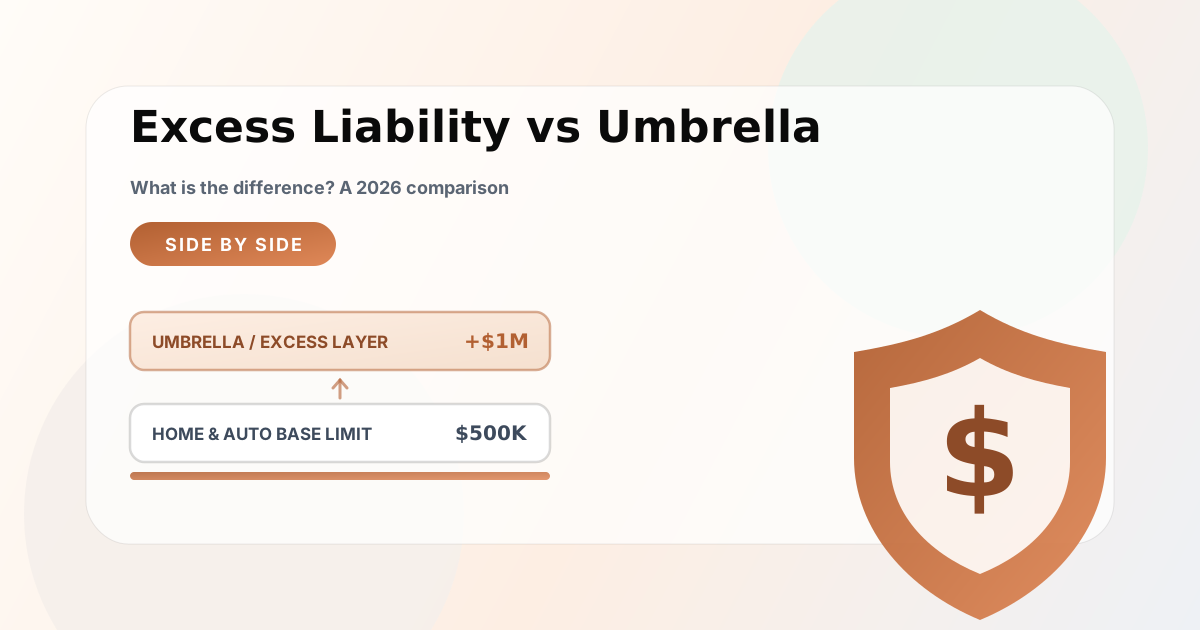
Excess Liability vs Umbrella Insurance | Dragon
9 min read
Home
Manufactured Home Insurance - Over 35% Go Uninsured
11 min read